Leaving MuleSoft: what a migration off it actually takes
"Leaving MuleSoft" is one of the most common threads in enterprise integration right now — usually right after the renewal quote. The flows work fine; it is the license and the runtime that hurt. Here is what the migration really involves, the costs nobody scopes, and how to make it a fixed number instead of an open-ended project.
"Anyone else looking at leaving MuleSoft?" is one of the most upvoted lines in enterprise integration forums right now, and it almost always shows up at the same moment: the renewal quote lands. The flows themselves usually work fine. What stings is the platform license plus the CloudHub runtime — a six-figure line item for integrations a smaller, cheaper stack could run. So teams start asking what it actually takes to get off.
Why teams leave
- The renewal: platform licensing plus CloudHub runtime is the real bill, not the flow logic.
- Over-engineered for what they run: a lot of orgs bought MuleSoft for an API-led vision they never fully used, and now pay enterprise pricing for a handful of load-bearing flows.
- Staffing: MuleSoft developers are scarce and expensive, so even small changes queue behind a specialist or a partner SOW.
What the migration actually involves (the part nobody scopes)
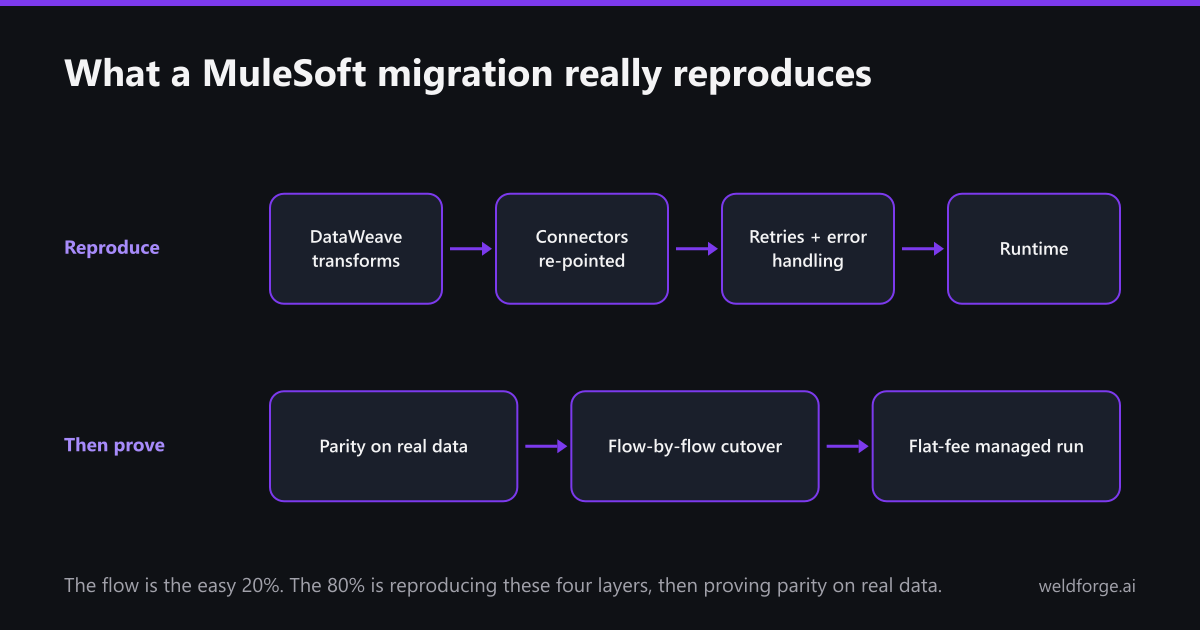
The flow diagram is the easy 20%. The hard 80% is reproducing the rest faithfully: re-expressing every DataWeave transform, re-pointing connectors to the same source and target systems, and reproducing the error handling, retries, and idempotency that keep a production integration from double-posting or silently dropping records. Then — the step that derails most migrations — proving parity on real data before you cut over, so finance and ops trust the new path as much as the old one.
The costs nobody puts in the plan
- Running both in parallel: you keep MuleSoft live while you build and validate the replacement, so for a stretch you are paying for both.
- The long tail of edge cases: the weird record, the partial failure, the timezone bug — the 5% that took 50% of the original build, rediscovered.
- Cutover risk: a big-bang switch is fast but scary; an incremental, flow-by-flow cutover is safer but longer. Either way it needs a plan and a rollback.
Make it a fixed cost, not an open-ended project
The reason "leaving MuleSoft" stalls is that it reads as an unbounded project — exactly the thing a stretched team does not want to own. That is the gap Weldforge closes. You tell us what each load-bearing flow connects, in plain English; we rebuild it, host it, and run it in our cloud for a flat monthly fee — DataWeave transforms re-expressed, retries and error handling reproduced, parity proven on your real data before cutover. No per-flow runtime license, no specialist to keep on staff. The migration becomes a known number and a managed service, instead of a renewal you grudgingly sign because leaving felt riskier than staying.