When Zapier stops making sense for agencies
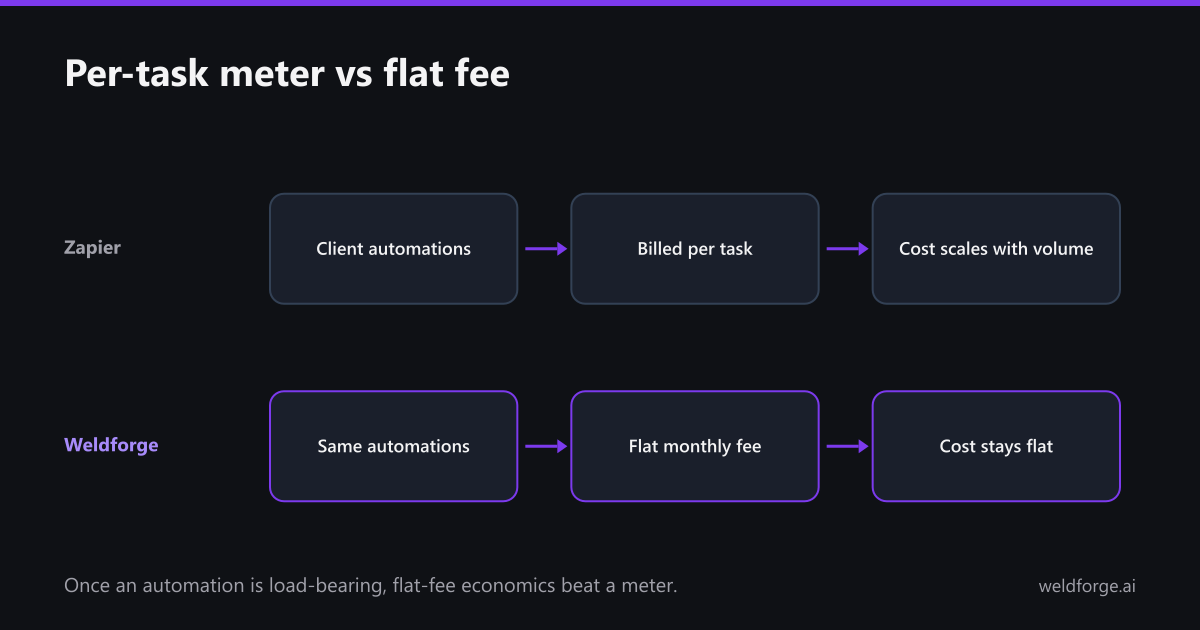
Per-task pricing scales with your success — which is exactly the problem once you run client automations at volume. Here is how agencies and MSPs keep margins, and when it pays to move a workflow to a managed flat-fee build instead of scaling tasks.
If you run client automations, you have probably felt it: a Zap that cost a few dollars a month quietly becomes a few hundred as volume and branching grow. Zapier is genuinely great for quick, low-volume work — but per-task pricing scales with your success, and for an agency or MSP that is the trap. Here is how to think about it.
Where the money actually goes
- Multi-step Zaps firing on every record: a single 6-step Zap on a busy trigger is usually 80% of the bill. Filters and a single code step often collapse it.
- Tasks billed on your account: if you host clients’ automations under your own seat, you absorb their task costs and your margin evaporates at renewal.
- Upkeep nobody scoped: every connector change, auth refresh, and edge case is billable time you rarely quote for.
The setup that keeps your margins
- Keep each client’s automations in their own account — you build as a guest, they own the seat. You are never holding the bag if they leave.
- Charge a flat monthly “automation care” retainer (monitoring + a set number of change requests) instead of eating per-task costs.
- Audit the high-task Zaps quarterly — that is where the bill hides.
When to stop scaling tasks
There is a crossover point — usually a few hundred dollars a month in tasks, or the moment the logic gets gnarly (custom transforms, weird auth, high volume) — where it is cheaper and more reliable to move that workflow to a managed, flat-fee build than to keep scaling Zapier tasks. That is the gap Weldforge fills: you describe what you want connected in plain language, we build it, host it, and run it in our cloud for a flat monthly fee — no per-task meter, no upkeep on your side.
Zapier still wins for fast, light, no-code automations. But once an automation becomes load-bearing for a client, predictable flat-fee economics beat a meter that punishes growth.