Is MuleSoft overkill for a simple Salesforce sync? (usually, yes)
It is one of the most-asked questions in the Salesforce threads, and the honest answer is that most teams asking it are being sold a platform to solve a two-object problem. Here is how to right-size the decision — native connector, lightweight automation, full iPaaS, or not owning it at all.
It comes up constantly: someone needs one object moving between Salesforce and a second system, a vendor or an architect suggests MuleSoft, and the number that comes back is an order of magnitude past what the problem felt like it was worth. The question that follows — "is this overkill?" — is the right question, and for a genuinely simple sync the answer is usually yes. But "simple" is doing a lot of work in that sentence, and the teams that get burned are the ones who guessed wrong about which side of the line they were on.
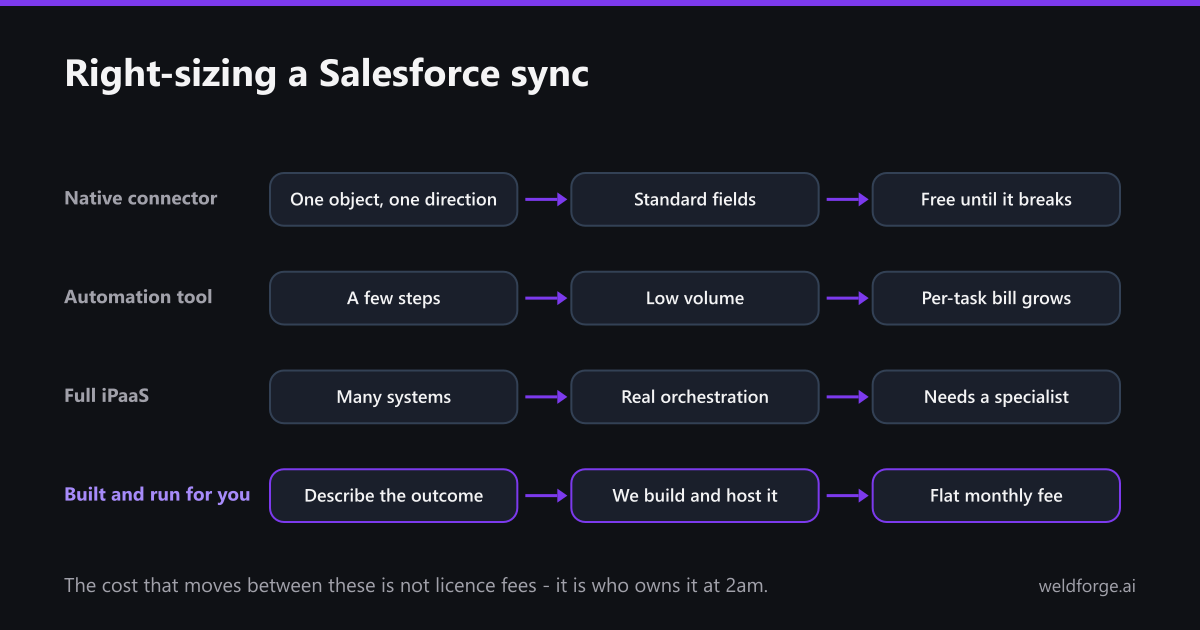
The four options, honestly
| Option | Fits when | What it really costs | Who maintains it |
|---|---|---|---|
| Native / packaged connector | One or two standard objects, one direction, standard fields | Cheap or bundled | Nobody, until it breaks — then you |
| Lightweight automation (Zapier, Make) | Low volume, few steps, forgiving data | Per-task pricing that climbs with growth | Whoever built it, forever |
| Full iPaaS (MuleSoft, Boomi, Workato) | Many systems, real orchestration, an in-house team | Licence plus a developer who knows it | Your platform team |
| Built and run for you | You want the outcome, not the tooling | A flat monthly fee | Us |
When the native connector really is enough
If you are syncing one standard object, in one direction, with fields that map one-to-one, and you can tolerate a failure sitting unnoticed until someone spots it — use the connector that ships with your system. No platform will make that job meaningfully better. The threads agree on this: the native path "works for simple syncs." Take the free win.
The four things that end "simple"
- Two directions. The moment records flow both ways you need conflict rules, and "last write wins" is a decision, not a default.
- A second data model. Customer matching, SKU and item crosswalks, multi-currency, revenue timing — none of this is connection work, and all of it is real work.
- Volume or timing pressure. Every-15-minutes across hundreds of thousands of records is a different engineering problem than a nightly file.
- Consequences. Once the sync touches invoicing, inventory or payroll, a silent failure is an incident, and somebody has to be on the hook for it.
Hit two or more of those and you are past what a connector or a task-based automation will carry gracefully. That is a genuine argument for middleware — but notice it is an argument for capability, not for a specific vendor.
The cost nobody puts in the business case
A full iPaaS assumes a person. Someone has to learn the platform, build in it, and stay current — and that person is far more expensive than the licence. This is exactly why teams end up looking to move off heavyweight platforms: not because the tool cannot do the job, but because the tool requires a specialist they no longer want to staff. If you are weighing MuleSoft for one sync, price the platform and the person, then compare that against what the integration is actually worth to you.
There is a fourth option: do not own it at all
Every option above is a way of buying tools to do the work yourself. That is the unexamined assumption in the whole debate. Weldforge is the other shape: you describe what you want connected in plain English, our AI drafts the field-by-field mapping and transforms, and we build it, host it and run it for a flat monthly fee — with a dashboard so you can watch it work. No platform to licence, no specialist to hire, no per-task meter. If your sync is simple, that is cheaper than standing up middleware for it. If it turns out not to be simple, the hard 80% is our problem instead of yours.