The migration nobody planned for: when the vendor deprecates your integration
Your integration did not break. A vendor put an end date on the method it was built with. That is the migration nobody budgeted, nobody owns, and everybody discovers about six weeks before the deadline. Here is how to find your exposure now, and how to stop being the org that keeps getting surprised.
There is a specific kind of thread that shows up in the ERP and CRM forums every few months, and it never starts with an outage. It starts with a release note. A vendor announces that the method your integration was built on is deprecated as of this year's first release, and that a year later you will not be able to create new ones at all. Nothing is broken. Nothing has slowed down. You now have a migration on the calendar that nobody scoped, nobody staffed, and nobody put in the budget.
The most quoted reply in one of those threads this month was not about the deadline at all. It was: the thing that worries me is not the cutoff date, it is that nobody internally owns this. That is the real finding. The deprecation is a date on a page. The problem is that the integration has no owner, so the date has no one to land on.
Why this keeps happening
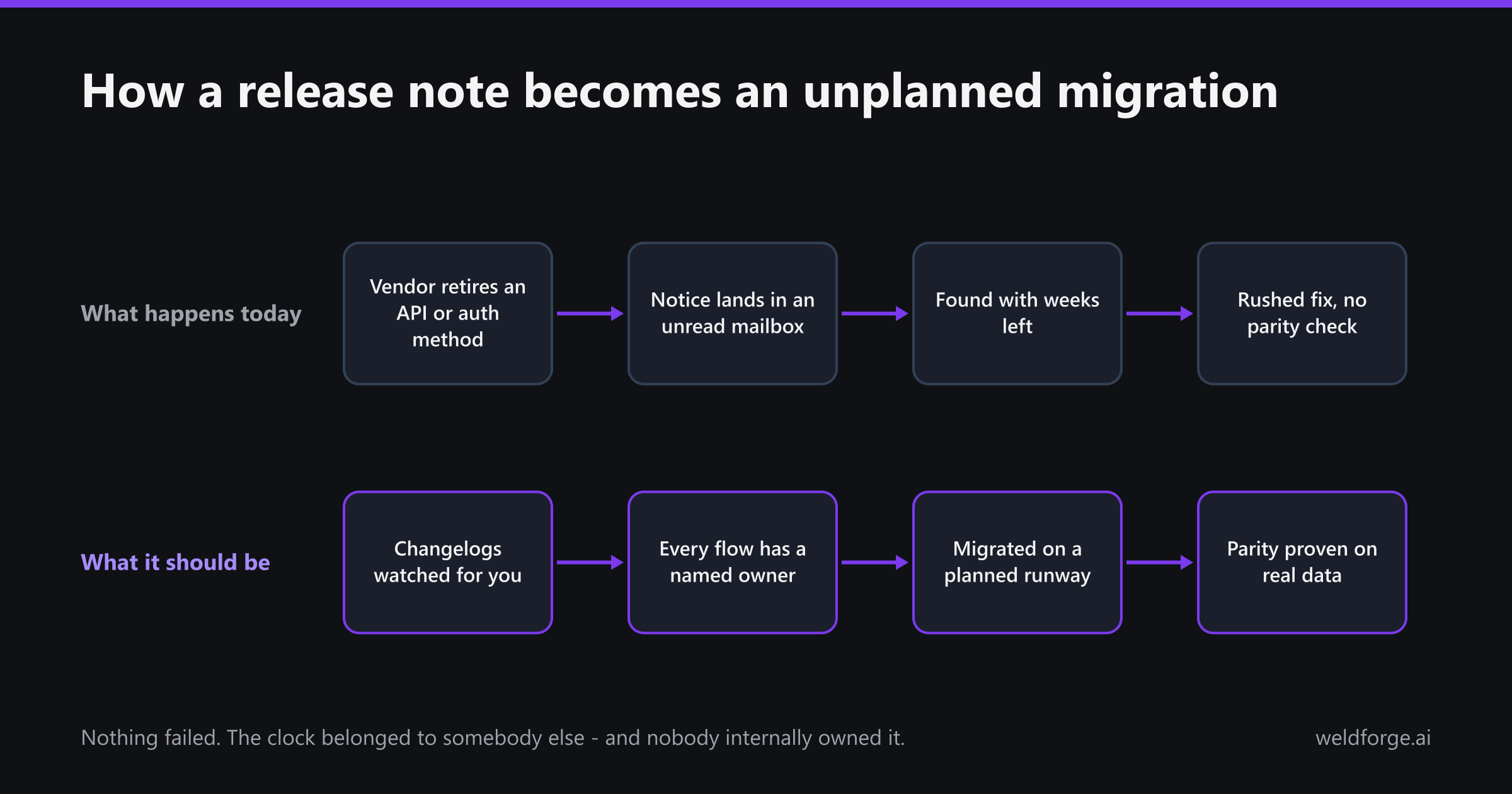
Every integration you run sits on top of somebody else's promises: an auth scheme, an API version, a record type, an export format, a rate limit. None of those are yours. Each vendor retires them on their own schedule, for their own reasons, and tells you in a release note that goes to an admin who is not the person who built the flow. A stack with six connected systems is not one deprecation clock — it is six of them, ticking independently, and you are subscribed to all of them.
What actually costs you
- The discovery gap. Most teams find out with weeks left, not quarters, because the notice went to a mailbox nobody reads as an engineering signal.
- No owner. The person who built it left, or it was a partner on a closed SOW. There is no name attached to the flow, so the ticket bounces until it is urgent.
- It is never a one-line change. A retired auth method or record type usually means re-testing every transform and every error path that touched it, not swapping a string.
- It arrives on someone else's schedule. You cannot negotiate the date, defer it to next quarter, or trade it against your roadmap. It lands whenever the vendor says it lands.
- The rushed fix becomes the next problem. Work done in a two-week panic is the code that has no tests, no parity check, and no documentation — so the next deprecation is worse.
Find your exposure before the release note does
- Inventory every live integration, with the systems and the specific API version or auth method each one uses. Most teams cannot produce this list, and that is the finding.
- Put a named owner on each one. Not a team, a person — the one who gets the release note and is expected to read it.
- Subscribe that owner to each vendor's developer changelog, not the general product newsletter. Deprecations are announced to developers first.
- Rank by blast radius. An integration that moves orders or invoices is a different risk class than one that syncs a marketing list, and should get a different amount of runway.
- Write down what "working" means for each flow — the records, the counts, the reconciliation — so a forced migration has something to prove parity against.
The structural fix: stop owning the clock
You can do all five of those and still be doing unplanned work forever, because the underlying arrangement has not changed: you own integrations built on other people's timelines, with staff whose actual job is something else. That is the arrangement Weldforge changes. You describe what needs to connect in plain English; we build it, host it in our cloud, and run it for a flat monthly fee. Watching the vendor changelogs, migrating off a retired auth method or API version, and proving the new path matches the old one on your real data is our job, not a project that lands on your team six weeks before a deadline. The deprecation still happens. It just stops being your emergency.